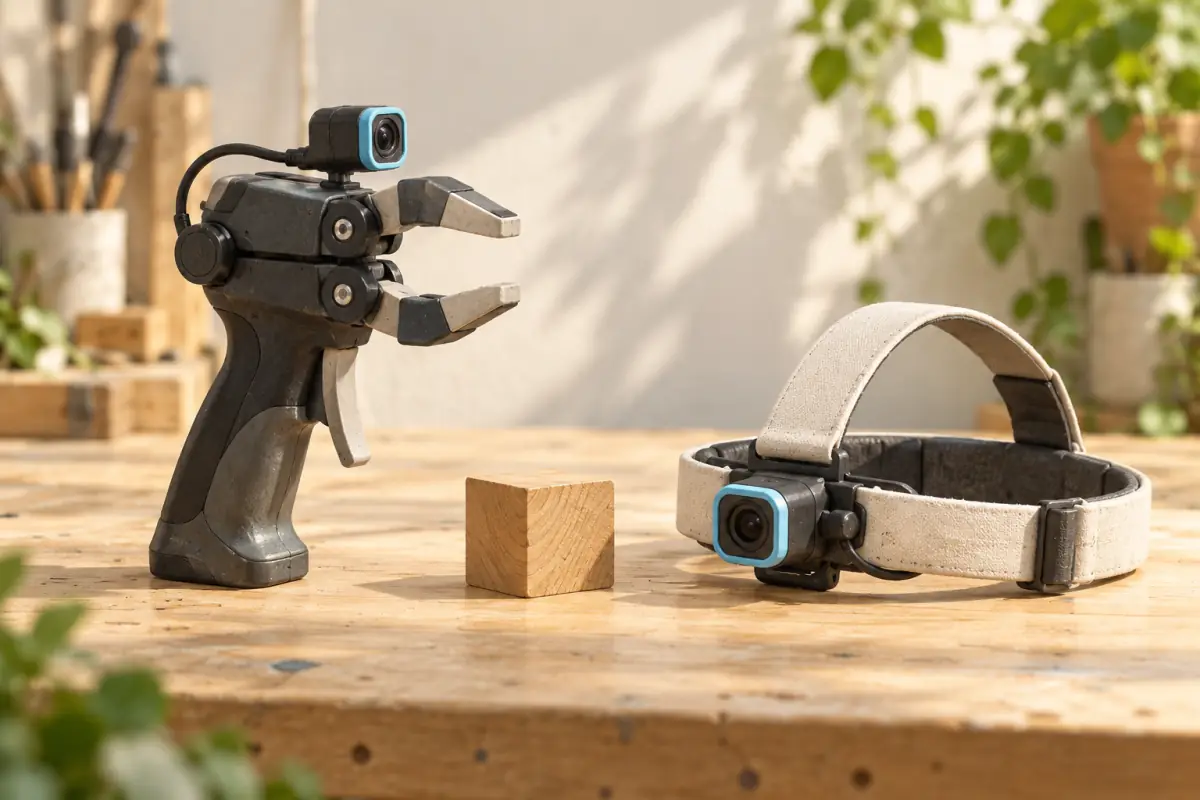
What UMI is designed to capture.
The Universal Manipulation Interface research project combines handheld grippers with cameras and a policy-learning framework. Its design connects human-operated gripper demonstrations to robot manipulation through a defined action representation and attention to latency.
What head-mounted capture changes.
With a head-mounted camera, a person can use familiar tools and their own fingers. The view follows their attention and movement through a workspace. This can preserve the sequence around an interaction, such as opening storage, selecting a tool and checking the result.
Compare the requirements, not just the hardware.
| Dimension | UMI-style collection | Head-mounted human video |
|---|---|---|
| Interaction | A person manipulates objects with a handheld gripper. | A person uses their hands and ordinary tools. |
| Perspective | Gripper-associated camera observations. | A camera near the person’s head. |
| Action representation | Defined within the UMI collection and policy method. | No measured robot action from video alone. |
| Task fit | Tasks compatible with the gripper and learning setup. | Tasks where natural hand use and surrounding context matter. |
| Checks | Tracking, motion representation, timing and robot compatibility. | Visibility, blur, continuity and annotation consistency. |
Use a concrete task to make the decision.
Consider moving a cup from a counter to a shelf. A gripper-oriented experiment needs to know whether the grasp and trajectory can be represented for its controller. A video-understanding experiment may instead need to identify the cup, the destination and the moment placement is complete.
Plan a small validation before scaling.
Choose representative tasks and inspect the required signal end to end. Can the processing pipeline produce the fields the learner expects? Is the outcome observable? Do the instructions allow consistent attempts without changing the task into something artificial?
Questions, answered.
Is a UMI gripper the same as a head-mounted camera?
No. UMI is a gripper-based collection and policy-learning method. A head-mounted camera records a person’s viewpoint and does not itself measure gripper or robot commands.
Can head-mounted footage provide robot actions?
Not by itself. Inferring motion from video is a separate process with assumptions and errors; it should not be confused with directly recorded robot commands.
Which approach is better for fine hand work?
Start by checking whether the task fits the gripper. Natural hand video may preserve the workflow, but occluded contacts or finger forces can still require additional sensing.
Sources and further reading
Primary references checked October 26, 2026.