Start with the training target.
Before choosing a capture method, write down the output your model must predict. A model that identifies the next task step needs a different target from a controller that predicts a joint command at each time step. “More demonstrations” is not specific enough to make that choice.
How the two methods compare.
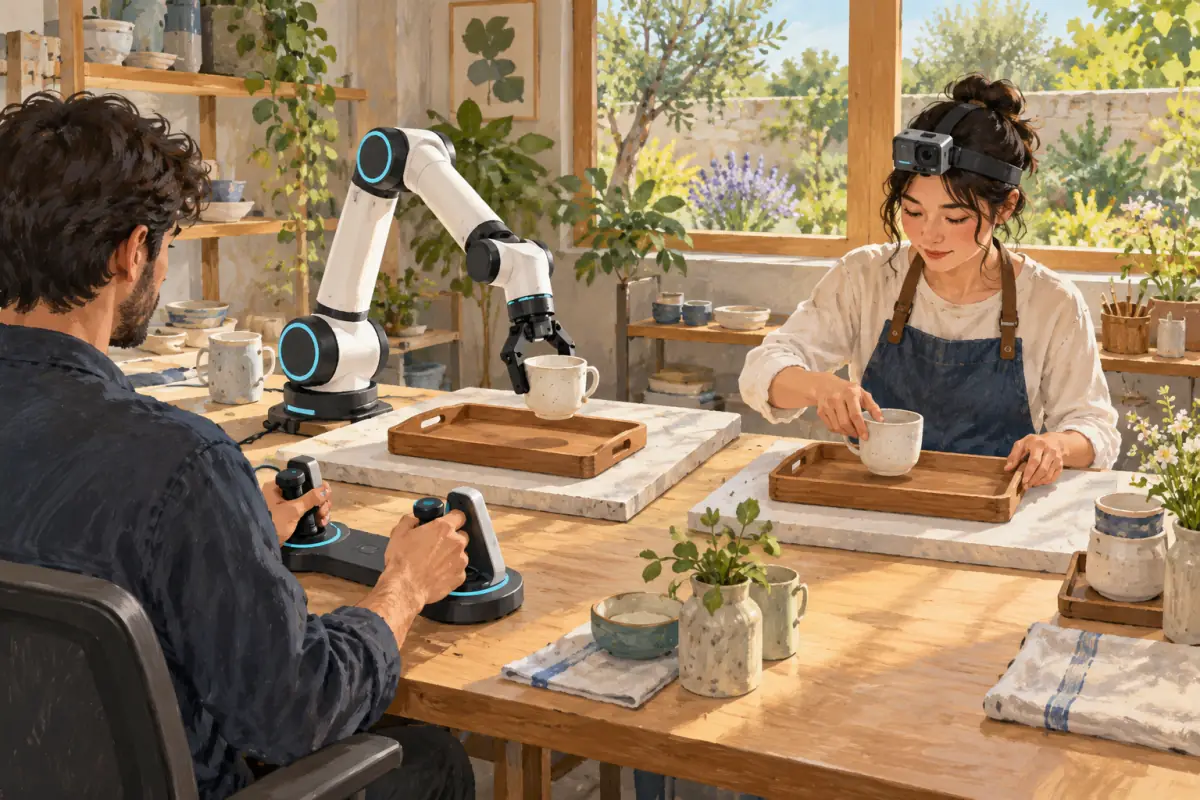
| Question | Teleoperation data | Egocentric human video |
|---|---|---|
| Who performs the physical task? | The robot, under human control. | The person wearing the camera. |
| What can be observed? | Robot camera views and whatever sensors are logged. | The person’s view of hands, tools and surroundings. |
| Where do actions come from? | Recorded commands, with their meaning documented. | No native robot commands in video alone. |
| What constrains collection? | Robot availability, workspace, operator interface and reset time. | Task access, camera visibility, permissions and recording quality. |
| What must transfer? | Across the training and deployment robot setups. | From human observation to the robot’s sensing and embodiment. |
Synchronization is part of the demonstration.
For a robot action target, distinguish when an image was exposed, when a command was issued and when the robot moved. A row number does not prove these events happened together. Clock offsets, dropped frames and latency can change the relationship the model learns.
Human video can preserve context that matters.
A worker may walk to a shelf, choose a tool, clear a space, complete a task and put equipment away. That broader sequence can help a team study task structure or visual context. It does not mean the same recording directly teaches a robot to execute each movement.
A combined plan needs a combined evaluation.
A team can investigate human video for visual or task representations and separately collect robot demonstrations for action supervision. The value of the combination depends on the model and task; it should be measured against an explicit baseline.
Choose based on the missing signal.
If the missing information is a robot command paired with an observation, discuss teleoperation and logging. If it is the variety of real work, object interactions or longer task context, consider egocentric collection. If both are missing, separate the requirements before estimating volume.
Questions, answered.
Can egocentric video replace teleoperation data?
Not when the training objective requires measured robot actions that the video does not contain. Human video and teleoperation can serve different parts of a learning pipeline.
Does teleoperation always produce training-ready data?
No. The required observations, actions, timestamps, units and episode boundaries still need to be logged and checked. A recording method is not a complete dataset specification.
Which method should a robotics team choose first?
Choose the method that captures the signal your current experiment is missing. Define the model inputs, target actions or labels, and evaluation before choosing collection volume.
Sources and further reading
Primary references checked October 26, 2026.